

Home > Blog > Best toys for children to share (toddlers to big kids)
Sharing is not a “good manners” switch you can flip. For toddlers, sharing is mostly turn-taking, waiting, and coping with big feelings, because true cooperation depends on brain skills that are still developing. Montessori leans into this by teaching “share by taking turns”, protecting a child’s concentration, and setting up an environment that makes conflict less likely.
TL;DR
Toddlers (roughly under 2.5 to 3) are usually in parallel play and are not reliably ready to share on demand.
Montessori’s core framing is: sharing = taking turns, not handing over an object mid-play.
The fastest way to reduce fights is not lectures, it is environment design:
- Duplicates of popular items (two scoops, two trucks).
- Big, open-ended sets (blocks, train tracks, play kitchen props).
- Activities where sharing is built-in (ball games, cooperative games).
Forced sharing often backfires and can model grabbing. Best “sharing toys” are usually multi-user by nature, not “one special object” kids must surrender.
“Before 2.5 years, toddlers are mostly interested in parallel play… rather than sharing their toys and playing together… In Montessori schools the ground rule is that we share by taking turns.”
Simone Davis - The Montessori Toddler
And a useful warning about forced sharing:
Taking a toy “because it’s time to share” can accidentally model grabbing as acceptable.
Sharing Toys in Early Childhood…
What does “sharing” mean for young children

Adults often mean “be generous”. Young children usually experience “sharing” as one of these:
- Turn-taking: “My turn, then your turn.”
- Using materials side-by-side: each child has their own tools, but shares a space.
- Co-building or co-creating: multiple pieces, one project (tracks, blocks, collage).
- Role-sharing in pretend play: “You be the chef, I’ll be the customer.”
Montessori’s key practical move is to treat sharing as a skill that grows out of waiting, language, and self-control, rather than a moral test.
When do kids learn to share toys (and is sharing realistic by age 4)
Two things can be true at once:
- Many children can share sometimes before 4.
- Reliable, low-drama sharing takes longer, because it depends on impulse control, language, and perspective-taking.
Montessori Toddler specifically notes that willingness to hand things over often changes around 14 to 16 months as toddlers develop a stronger sense of “I” and ownership.
A practical, evidence-aligned summary by age (also consistent with play-stage research) looks like this:
Table 1: Sharing readiness by age (what is realistic)
| Age | What play often looks like | What “sharing” can realistically mean | What helps most |
|---|---|---|---|
| 0–1 | Mostly solitary exploration | No expectation to share | Gentle modelling, lots of duplicates |
| 1–2 | Parallel play begins; “mine” emerges | Brief handovers, often adult-supported | Short turns, simple scripts (“my turn”) |
| 2–3 | Parallel plus early associative moments | Turn-taking with help; conflict is common | Timers, duplicates, adult coaching without forcing |
| 3–4 | More associative play; more language | Short turns can work; sharing is improving | Problem-solving language, cooperative setups |
| 4+ | Cooperative play emerges more often | More consistent turn-taking and early fairness | Shared goals, group games, collaborative projects |
This aligns with the idea that cooperative play becomes more common around 4+, once children have more self-regulation and perspective-taking.
So, are children able to share toys by age 4?
Often yes, more consistently than earlier, but not perfectly and not in every situation, especially when tired, overstimulated, or attached to a particular item.
Why toddlers often cannot share, even when taught

It is not stubbornness. It is capability.
Key limiting factors described in the research summary include:
- Impulse control and emotional regulation are still developing. The prefrontal systems involved are “under construction”, which makes waiting and giving things up genuinely hard.
- Empathy and perspective-taking are immature. Around 2 years you may see early empathy, but consistent perspective-taking strengthens later (often around 4).
- Fear of not getting it back. Toddlers can feel real anxiety about losing a treasured object.
- Need for autonomy and control. If life feels controlled, “my toy” becomes a place to assert power.
- Overstimulation or fatigue. When resources run low, sharing collapses first.
This is why expectations matter. Montessori explicitly advises adjusting expectations before about 2.5 years, because parallel play is normal.
How to teach a toddler to share toys (without power struggles)

Step in as a “bodyguard” if it gets physical, rather than forcing a moral lesson mid-meltdown. Builds communication and regulation skills without escalating conflict. Use a timer (optional) Set a clear, visible timer so the turn change is concrete. Converts “loss” into a predictable sequence. Protect special toys Put away deeply loved comfort items during playdates. Open-ended sets with many pieces
1) Teach turn-taking language, not “hand it over”
Montessori gives very practical scripts:
-
Support the child to say: “My turn. It will be available soon.”
-
Support the waiting child: “It will be available soon.”
-
Step in as a “bodyguard” if it gets physical, rather than forcing a moral lesson mid-meltdown.
2) Use a timer as a fairness tool (optional)
A timer makes the limit concrete. It converts “loss” into “sequence”.
3) Protect “special toys”
A developmentally fair strategy is to put away the one beloved comfort item during playdates. This prevents unnecessary grief and protects attachment.
4) Model the behaviour, do not perform it to them
Children learn most from what we do repeatedly. The research summary stresses modelling asking, waiting, and trading, rather than adults grabbing items in the name of sharing.
5) Avoid forced sharing
Forced sharing can stop a fight in the moment but can reduce generosity later and can teach the wrong lesson (power wins).
When should adults intervene in toy conflicts

A simple rule that matches the research summary:
Step in when:
-
There is hitting, biting, throwing, or clear escalation.
-
One child is repeatedly dominating a quieter child.
-
A child is sliding into a full meltdown and cannot recover alone.
Sharing Toys in Early Childhood…
Step back when:
-
It is minor and safe.
-
Children are in productive parallel play.
-
The main issue is impatience rather than harm.
Sharing Toys in Early Childhood…
Your role becomes a coach:
-
Name what you see (“You both want the truck.”)
-
Pause.
-
Offer one option if they are stuck (trade, timer, find a similar toy).
Sharing Toys in Early Childhood…
Best toys for toddlers to share (and why they work)
For toddlers, the “best sharing toys” are often toys that let children play side-by-side or make sharing feel like turn-taking, not surrender.
These categories consistently reduce conflict:
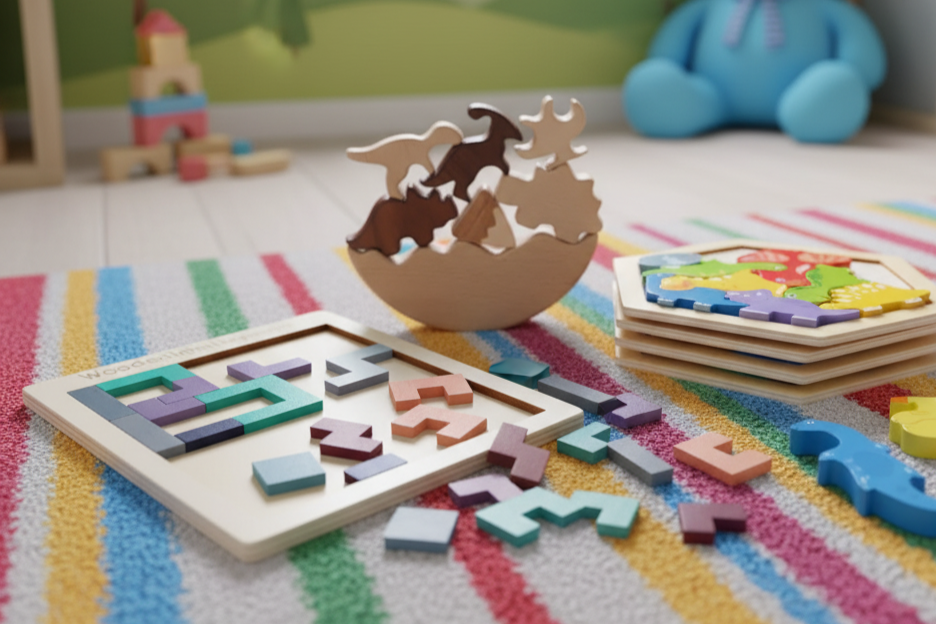
Open-ended sets with many pieces
-
Blocks (wooden blocks, large interlocking blocks, magnetic tiles for older toddlers)
-
Train tracks with lots of track pieces
Why they work: Many parts means fewer scarcity fights. Children can build in parallel and later connect builds into a shared project.
Sensory play stations (shared medium, separate tools)
-
Sand and water play (with multiple scoops, cups)
-
Play dough with multiple tools
Why they work: The medium feels abundant, and parallel play is natural.
Pretend play sets with multiple roles
-
Play kitchen with lots of food and dishes
-
Dress-up box, puppets
Why they work: Roles structure cooperation. Props pass naturally within the story.
“Built-in turn-taking” play
-
Rolling a ball, simple throwing and catching games
-
Very simple board games for preschoolers (older toddlers with support)
Why they work: The rules create fairness without constant adult negotiation.
Best toys for all kids to share (toddlers through early primary)
As children grow, you can widen the mix to include more complex collaboration and rule-based play.
Table 2: Toy types that scale for sharing across ages
| Toy / material type | Best for ages | What it teaches socially | Why it reduces conflict |
|---|---|---|---|
| Blocks (lots of pieces) | 1.5–8+ | Parallel play → co-building | Many parts, flexible play |
| Train tracks / marble runs | 2–10+ | Joint planning, shared goals | Shared build, divided tasks |
| Play kitchen / pretend props | 2–7+ | Role negotiation, empathy | Multiple roles keep play moving |
| Art “buffet” (paper, crayons, glue) | 2–10+ | Turn-taking tools, complimenting peers | Easy to duplicate, low-stakes swapping |
| Sensory bins (with multiple tools) | 1.5–6+ | Sharing space, calm regulation | Abundant medium, parallel play friendly |
| Cooperative games (everyone wins together) | 3.5–8+ | Teamwork, shared success | Less “me vs you” tension |
| One large ball and outdoor play | 2–10+ | Turn-taking, waiting, fairness | The game forces rotation and re-engagement |
Montessori setup tips that make sharing easier (without forcing it)
Montessori environments reduce conflict by design:
- Some duplicates, especially for toddlers (two dolls, multiple puzzles) to reduce constant competition.
- Some limited items to teach waiting and turn-taking in a calm way.
- Adults coach language: “Can I use it when you’re finished?” rather than refereeing.
A simple home translation:
- Put out fewer toys, but the right ones (open-ended, multi-piece, duplicable).
- Make “waiting” visible (timer, a “waiting spot”).
- Teach one repeatable script, and stick to it.
Neurodiversity and sharing: what changes
Some neurodivergent children (including autistic children) may find parallel play especially comfortable and meaningful. Sensory play and side-by-side setups can support social connection without forcing intense interaction.
Practical adjustments that reduce stress:
- Keep the environment calm and predictable.
- Use structured turn-taking games when free-play negotiation is overwhelming.
- Use duplicates of favourite items to prevent a single-object flashpoint.
Safety note (toy sharing basics)
When multiple children share toys, prioritise:
- Age-appropriate sizing (choking risk for under-3s).
- Cleanability for mouthed toys.
- Checking for loose parts and damage.
For toy safety checklists, the American Academy of Pediatrics guidance on buying safe toys is a solid starting point. HealthyChildren.org
FAQs
When do babies start sharing toys?
Babies may hand objects to adults or briefly allow contact with an object, but this is not the same as reliable sharing between children. Early “sharing-like” moments are usually adult-led and short.
Source: ZERO TO THREE: Helping Young Children With Sharing
When do kids learn to share toys?
Sharing develops gradually and is closely tied to self-regulation, language, and perspective-taking. For many children, consistent sharing becomes more realistic as cooperative play increases, often around preschool age.
Source: Pathways.org: 6 Stages of Play Development
Are children able to share toys by age 4?
Often yes, more consistently than earlier, but not perfectly and not in every situation. Sharing can break down when children are tired, overstimulated, or highly attached to a specific item.
Source: CDC: Milestones by 4 Years
Why won’t my child share toys?
Common reasons include immature impulse control, fear of not getting the toy back, the need for autonomy and control, and overstimulation or fatigue. In toddlers, this is often developmental rather than defiance.
Source: ZERO TO THREE: Helping Young Children With Sharing
How should adults help toddlers learn to share?
Focus on turn-taking language and predictable routines rather than forced handovers. Adults can coach short scripts, support waiting, and step in mainly for safety or escalation.
Source: Cleveland Clinic: 7 Tips to Encourage Your Child to Share
What is realistic to expect at ages 1, 2, 3, and 4+?
At 1 and 2, parallel play is common and sharing is usually brief and adult-supported. At 3, turn-taking improves but conflict is still normal. By 4+, cooperative play and more consistent sharing often increase, especially with structure and practice.
Source: Pathways.org: 6 Stages of Play Development
Final thoughts
If you remember one idea, make it this: sharing is mostly a developmental skill, not a moral choice, especially for toddlers. Montessori’s “share by taking turns” works because it respects concentration, reduces power struggles, and teaches patience in a way a young brain can actually manage.
When you choose toys that are naturally multi-user, and you set the room up with abundance and duplicates where needed, you can spend far less time mediating and far more time watching children practise social skills in a calm, realistic way.
References
- The Montessori Toddler (Simone Davies, publisher page)
- The Montessori Baby (Simone Davies & Junnifa Uzodike, publisher page)
- The Montessori Child (Paula Polk Lillard & Lynn Lillard Jessen, publisher page)
- ZERO TO THREE: Helping Young Children With Sharing
- Pathways.org: 6 Stages of Play Development
- American Academy of Pediatrics: Power of Play in Early Childhood
- HealthyChildren.org (AAP): How to Buy Safe Toys
- HealthyChildren.org (AAP): What to Look for in a Toy
- CDC: Developmental Milestones (Learn the Signs. Act Early.)
- CDC: Milestones by 4 Years
- Cleveland Clinic: 7 Tips to Encourage Your Child to Share
- HealthyChildren.org (AAP): Social Development in Preschoolers